How Long Does It Take a Child to Finish Madani & Noorani Qaida Online?
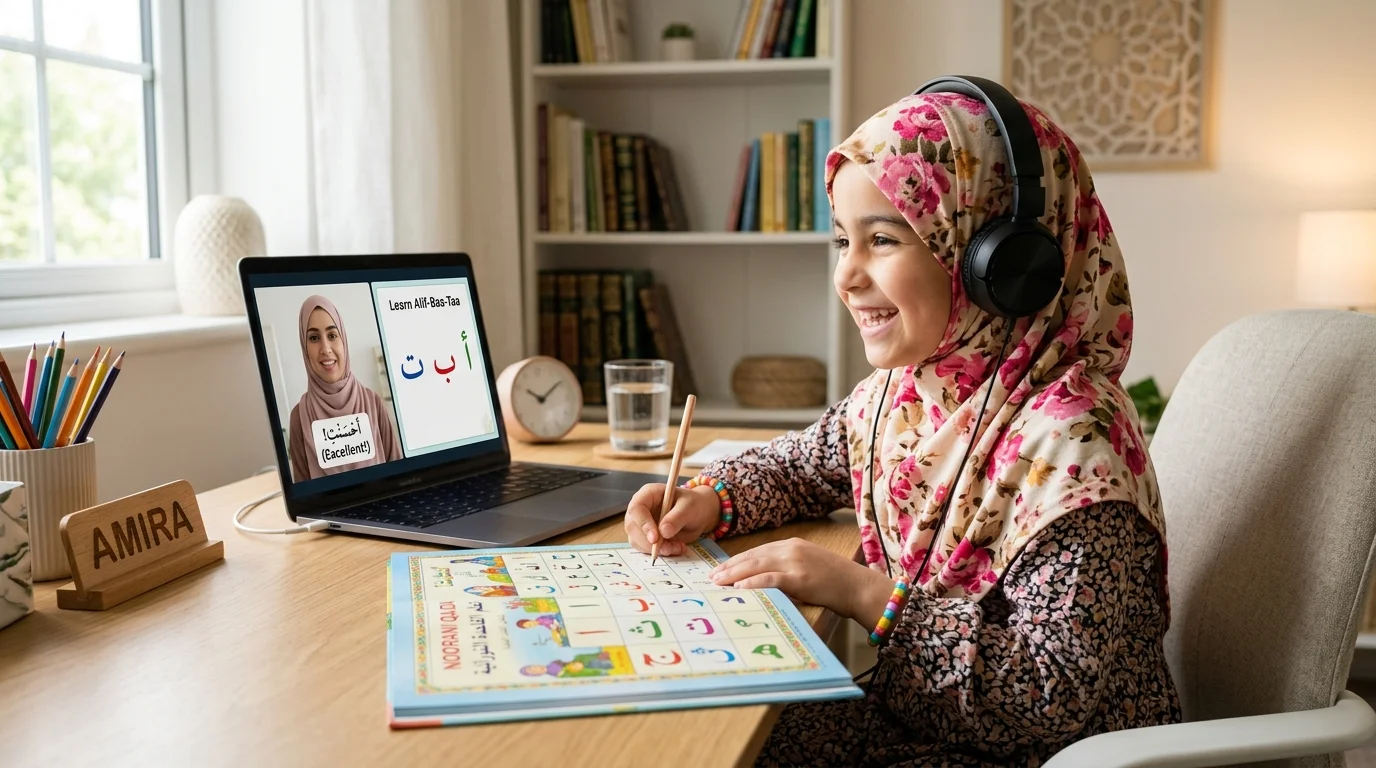
When Muslim parents enroll their children in Quranic education, the foundational step is mastering the basic reading primer—most commonly known as Noorani Qaida or Madani Qaida. One of the most frequent questions parents in the USA, UK, Canada, and Australia ask our academic counselors is: "How long will it take for my child to complete the Qaida and start reciting the Holy Quran directly?"
Understanding the realistic timeline is essential for setting healthy expectations, tracking milestones, and ensuring that speed is never prioritized over accurate Tajweed pronunciation (Makharij). In this comprehensive parent guide, we outline the exact timeframes, age-by-age factors, chapter pacing, and proven strategies to help your child master basic Arabic reading smoothly.
The General Timeline: 3 to 6 Months
For an average child taking live 1-on-1 online Quran classes 3 to 5 days per week (30 minutes per class), completing Madani or Noorani Qaida typically takes between 12 to 24 weeks (3 to 6 months).
However, learning pace is inherently individual. A 10-year-old child with prior exposure to Arabic sounds will naturally progress faster than an energetic 4-year-old who is learning the alphabet for the first time. Below is a detailed breakdown by age group:
Chapter-by-Chapter Pacing in Madani / Noorani Qaida
A standard Qaida contains around 17 to 28 progressive lessons. Here is how expert online Quran teachers pace these critical milestones:
Phase 1: Individual Letters (Huruf-e-Mufradat) — Weeks 1 to 3
Students learn to recognize all 29 Arabic alphabet letters from Alif (ا) to Yaa (ي). The tutor focuses extensively on correcting throat letters (ح, خ, ع, غ), heavy letters (ص, ض, ط, ظ, ق), and soft letters (ث, ذ), ensuring clean throat and tongue articulation points right from the start.
Phase 2: Compound Letters (Huruf-e-Murakkabat) — Weeks 4 to 6
Arabic letters change shape when joined together in words. In this phase, children practice identifying initial, medial, and final letter forms (e.g., Baa-Alif, Taa-Seen, Jeem-Haa). This eliminates confusion when reading full Quranic script.
Phase 3: Vowel Movements (Harakaat & Tanween) — Weeks 7 to 11
Children learn short vowels—Fatha (Zabar), Kasra (Zair), and Damma (Paish)—and double vowels (Do Zabar, Do Zair, Do Paish). Tutors train students strictly never to stretch short vowels (no Majhool recitation), which is a common habit among non-Arabic native speakers.
Phase 4: Sukoon, Madd, and Tashdeed — Weeks 12 to 18
The core rules of Quranic reading: Sukoon (Jazm), Letters of Leen, Standing Harakaat (Khari Harakaat), Maddah elongation, and Tashdeed (Mushaddad letters). By this point, the child is blending multi-syllable Arabic words fluently.
Phase 5: Advanced Tajweed & Final Exam — Weeks 19 to 24
The concluding lessons teach Rules of Noon Sakin and Tanween (Izhar, Idgham, Iqlab, Ikhfa), Rules of Raa and Laam of Jalalah, stopping signs (Waqf), and full sentence reading. The student undergoes a comprehensive final assessment before graduating to Juz Amma (Para 30).
5 Key Factors That Speed Up Qaida Completion
- 1-on-1 Dedicated Tutor: In private classes, 100% of the 30-minute session is focused on your child. In physical group madrasas with 15 kids, each child typically receives only 2 to 3 minutes of personal listening time.
- Consistency (4-5 Days/Week): Regular short classes are far superior to a single long weekend class. Young children retain Arabic phonic patterns best when exposed to them daily.
- 10 Minutes of Daily Home Practice: Having your child read their assigned Qaida page once before dinner or after school solidifies memory retention by over 300%.
- Screen-Sharing Interactive Tools: Digital Noorani Qaida software with color-coded highlighting helps visual learners grasp complex letters effortlessly.
- Positive Reinforcement: Certified tutors who reward kids with digital stars, praise, and milestone badges keep young minds enthusiastic.
Golden Rule for Parents: Quality Over Speed
Never rush a child through Noorani or Madani Qaida. The Qaida is the fundamental foundation of your child's lifelong Quran recitation. If pronunciation flaws or incorrect letter sounds are overlooked early on, correcting them later during Nazra Quran becomes ten times harder. A child who completes Qaida thoroughly in 5 months will recite the Holy Quran with effortless fluency for the rest of their life.
Frequently Asked Questions (FAQ)
On average, a child takes between 3 to 6 months to complete Madani or Noorani Qaida when taking 3 to 5 live 1-on-1 classes per week with certified Tajweed tutors.
Both are globally recognized, time-tested syllabi. Noorani Qaida is concise and classic, while Madani Qaida features additional color-coded exercises, visual clarity, and practical stopping rules. At TajweedHub, our certified tutors teach whichever Qaida parents prefer.
Yes! Online Quran academies use interactive screen sharing, digital whiteboard pointers, and short 30-minute engaging lessons tailored specifically for toddlers and young beginners.
Upon completing the Qaida, the student graduates directly into the Nazra Quran Course, beginning with Surah An-Nas and short Surahs in Juz 30 (Amma Para), before progressing smoothly through the entire Quran.
Start Your Child's Noorani & Madani Qaida Journey Today
Experience our gentle, interactive 1-on-1 Qaida classes with certified male and female scholars. No credit card required.
Book 3-Day Free Trial Class